

Loading Lesson


Haiti: A Brief Introduction
The Caribbean island of Haiti was originally inhabited by the Arawak group of indigenous peoples including the Taíno people. When Christopher Columbus arrived in 1492 there were five independent kingdoms on the island: the Xaragua, Higuey (Caizcimu), Magua (Huhabo), Ciguayos (Cayabo or Maguana), and Marien (Bainoa). Many distinct languages also existed. Spanish colonisation* began the next year, and the island began to be known to Europeans as Hispaniola. In 1503 the Spanish began to import enslaved African people.
By 1508, the Taíno population of about 400,000 was reduced to 60,000, and by 1514, only 26,334 remained. The French officially colonised the island from 1665, and the island was renamed Saint-Domingue. Following the organised rebellion of enslaved* Africans, the name Haîti was adopted by Haïtian revolutionary Jean-Jacques Dessalines in 1804, as a tribute to the Amerindian predecessors.
* Colonisation = to settle among a take control over a land and its indigenous people, often through forceful means.
* Enslaved = to cause someone to lose their freedom of choice and action; slave.

The Caribbean island of Haiti was originally inhabited by the Arawak group of indigenous peoples including the Taíno people. When Christopher Columbus arrived in 1492 there were five independent kingdoms on the island: the Xaragua, Higuey (Caizcimu), Magua (Huhabo), Ciguayos (Cayabo or Maguana), and Marien (Bainoa). Many distinct languages also existed. Spanish colonisation* began the next year, and the island began to be known to Europeans as Hispaniola. In 1503 the Spanish began to import enslaved African people.
By 1508, the Taíno population of about 400,000 was reduced to 60,000, and by 1514, only 26,334 remained. The French officially colonised the island from 1665, and the island was renamed Saint-Domingue. Following the organised rebellion of enslaved* Africans, the name Haîti was adopted by Haïtian revolutionary Jean-Jacques Dessalines in 1804, as a tribute to the Amerindian predecessors.
* Colonisation = to settle among a take control over a land and its indigenous people, often through forceful means.
* Enslaved = to cause someone to lose their freedom of choice and action; slave.
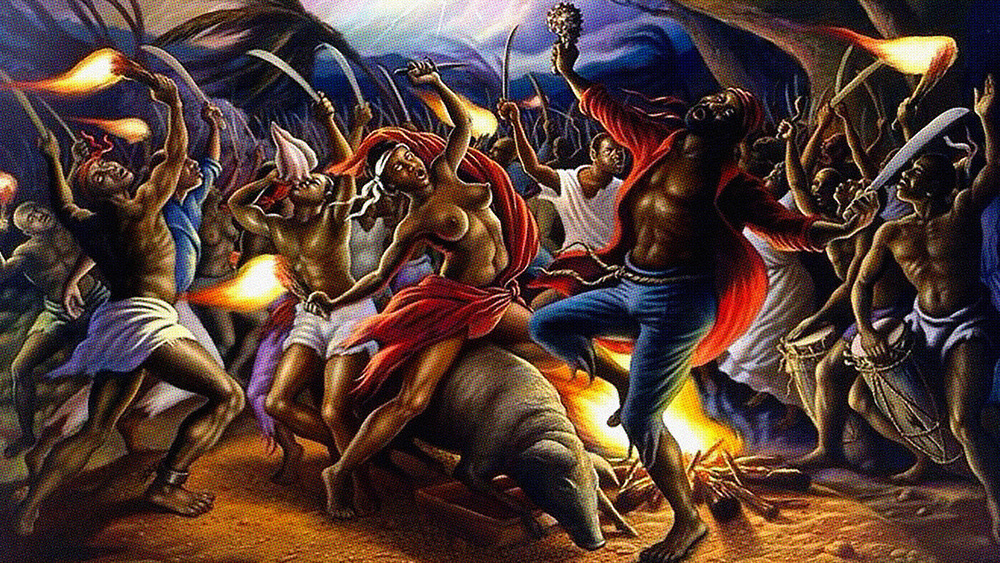
Rise-up
What did it take for enslaved Africans
to resist and rise-up in Haïti?

Independence Day
Listen to the following poem: Independence Day
Written by Lawrence Hoo
Performed by Mikael Techane
PLAY
Listen to the following poem: Independence Day
Written by Lawrence Hoo
Performed by Mikael Techane
PLAY
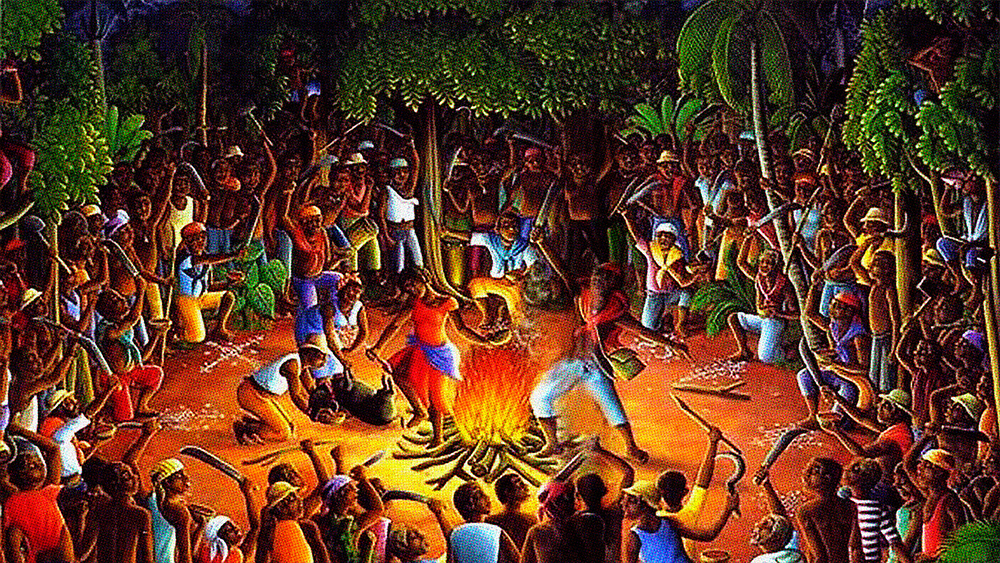
Artists impressions of the rituals that Boukman and his followers practiced.

Portrait of Dutty Boukman
The following prayer has been attributed to
Boukman at the vodou ceremony:
"The God who created the earth; who created the sun that gives us light. The God who holds up the ocean; who makes the thunder roar. Our God who has ears to hear. You who are hidden in the clouds; who watch us from where you are. You see all that the white has made us suffer. The white man's God asks him to commit crimes. But the God within us wants to do good. Our God, who is so good, so just, Orders us to revenge our wrongs. It's He who will direct our arms and bring us the victory. It's He who will assist us. We all should throw away the image of the white men's god who is so pitiless. Listen to the voice for liberty That speaks in all our hearts."
"The God who created the earth; who created the sun that gives us light. The God who holds up the ocean; who makes the thunder roar. Our God who has ears to hear. You who are hidden in the clouds; who watch us from where you are. You see all that the white has made us suffer. The white man's God asks him to commit crimes. But the God within us wants to do good. Our God, who is so good, so just, Orders us to revenge our wrongs. It's He who will direct our arms and bring us the victory. It's He who will assist us. We all should throw away the image of the white men's god who is so pitiless. Listen to the voice for liberty That speaks in all our hearts."

Battle for Palm Tree Hill, Saint Domingue - Haitian Revolution
Add a comment.
Please let us know your thoughts.
Choose your Avatar
I AM NOT A ROBOT
SUBMIT

"I would have loved to have seen things differently when I was younger."
Tom Simplson

"We’re slowly trying to find it ourselves, Because it was lacked in the curriculum"
A Student

"It's incredible that his history still hasn't been given a fair representation,"
Lawrence Hoo
"It has become a tsunami of enlightenment and information"
A Student
Please let us know your thoughts.
Choose your Avatar
I AM NOT A ROBOT
SUBMIT
"I would have loved to have seen things differently when I was younger."
Tom Simplson
"We’re slowly trying to find it ourselves, Because it was lacked in the curriculum"
A Student
"It's incredible that his history still hasn't been given a fair representation,"
Lawrence Hoo
"It has become a tsunami of enlightenment and information"
A Student