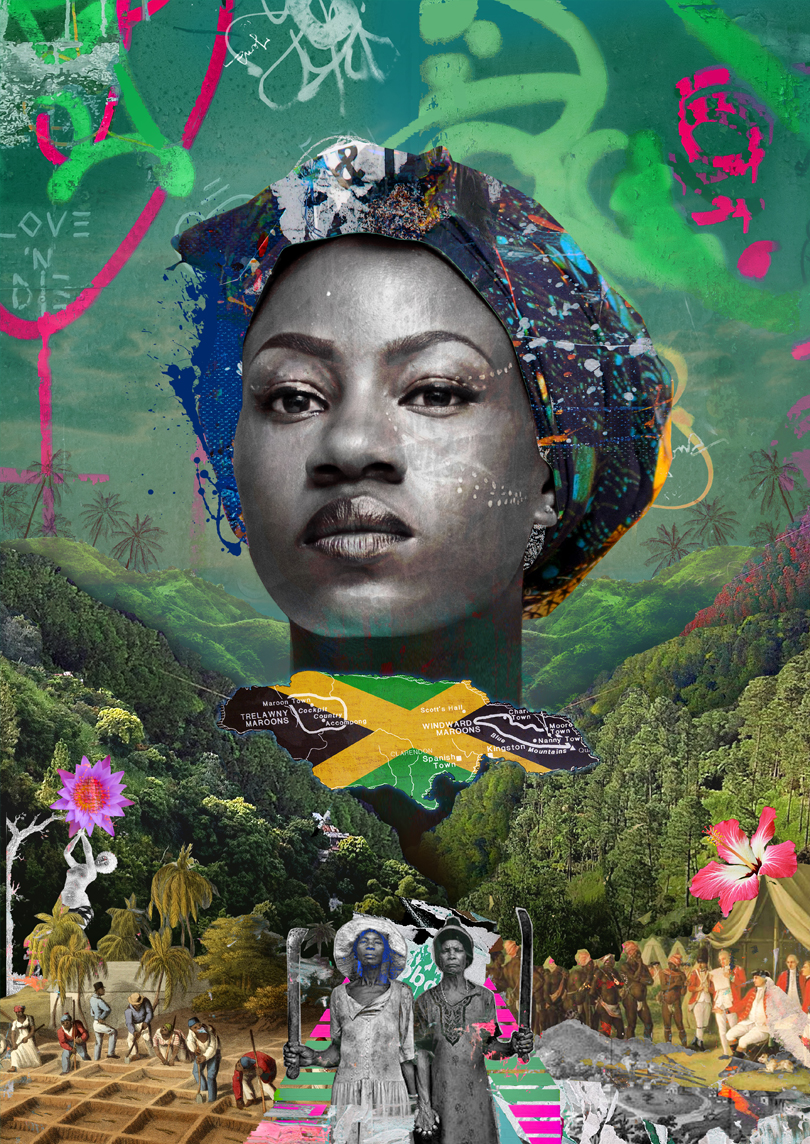
Source 1
Researching the history of Nanny has been a challenge for historians because there are only four written references to her in documents from the time. Much of what we know about Nanny comes from stories that have been passed from generation to generation by the Maroons. Some of the stories of Nanny also come from European soldiers who were eager to portray her in a sexist and racist way.
Nanny was a leader of the Maroons during the early 1700s. No one knows exactly how Nanny arrived in Jamaica although it seems that she was born in Ghana and was from the Akan people. Some historians believe that she was a Queen in Africa and came to Jamaica to free her people. Others believe that she was enslaved and then escaped to join the Maroons. Africans who joined the Maroons brought with them guerilla tactics for fighting the British that they had learnt in Africa. The Maroon communities, isolated in the mountains, were organised around African culture.
Akan society did not have the same attitudes to women as Western societies at the time. African attitudes to women were inherited by the Maroons and women were able to be community and spiritual leaders. Women were largely responsible for the farming success of the Maroons. The British could not believe that they were fighting a woman and made up fantastical stories about Nanny.
Nanny was a spiritual leader, this was an important part of her leadership. The Maroons practiced Obeah which was derived from African spirituality. Nanny was skilled in providing herbal remedies which helped her gain the trust of her people. One mythical story of Nanny is that she used her spiritual powers to lure British soldiers to their deaths in a pot of boiling water. Historians think that this story comes from the fact that the Maroons used their knowledge of the mountains and waterfalls to capture British soldiers. Another story that is told about Nanny is that when her people were starving, she heard the voice of her ancestors telling her to be patient for one more day. The next day she found three pumpkin seeds in her pocket and planted them. In a very short time the plants had grown and she could feed her people. Pumpkin Hill is located today in Portland, Jamaica, near the Blue Mountains.
Nanny was an incredible military leader. During the 1730s Maroons led a guerrilla war against the plantation owners. This was known as the First Maroon Wars. They did not fight British soldiers face to face but ambushed them. It is believed that Nanny taught the Maroons guerrilla tactics such as camouflaging themselves as trees. She is also credited with teaching her soldiers how to use a cow horn for long distance communication by blowing into it. Maroons also developed a method of cooking by smoking meat underground so that there was no smoke visible to the enemy. This is called “ jerk” and is still used in cooking Jamaican food today. Maroon communities still exist today and in memorial ceremonies remember their ancestors by blowing the horn and dressing in camouflage.
Eventually the British accepted that they could not defeat the Maroons and a peace treaty was signed. We know that Nanny did not sign the peace treaty with the British but historians can’t be sure whether this is because the British did not accept her as a leader or because she refused to sign the treaty.
Source A
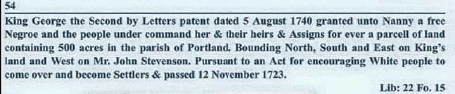
In 1740, after the end of the First Maroon War Nanny’s name appears on official British ‘Land Grant’ returns in Jamaica. These Colonial reports would have been sent to London for official records. It is quite incredible that at this time when the slave trade was still legal, the British were forced to give an African woman land for her community to live on as free people.
Source B
A British junior officer described her as “[having] a girdle around her waist, with nine or ten different knives hanging in sheaths to it, many of which I doubt not had been plunged into human flesh and blood.”