
Teacher’s notes
Imhotep
Links to the National Curriculum for Key Stage 3 History
Students will gain historical perspective by placing their growing knowledge into different contexts, understanding how the scientific knowledge held within societies in the ancient world (specifically Ancient Africa) has formed the basis of today’s scientific knowledge. Students will also be invited to consider how historical evidence can paint a different picture to the one commonly shown in popular culture.
This lesson would easily fit into schemes of learning on the following topics:
• The ancient world and the ancient kingdoms of Africa
• The history of scientific knowledge
• Critical thinking around the representation of Imhotep in popular culture
• The lesson is also relevant to Spiritual, Moral, Social and Cultural SMSC development
The lesson gives students the ability to be reflective about their own non-religious beliefs and perspective on life, their knowledge of, and respect for, different people’s feelings and values. It will build their understanding of the history of Africa from the earliest times to the present day: Especially how the actions and views of people in Africa have shaped Europe, and vice versa. It offers the opportunity to develop reasoned views about moral and ethical issues. Giving students a chance to understand and appreciate the viewpoints of others on historical issues.
This lesson follows the enquiry question:
How Did A God Become A Demon?
The lesson begins with an introduction to Ancient Africa and the griot tradition of preserving and passing on historical knowledge. The lesson then explores the achievements of Imhotep in ancient Egypt in around 2700 BCE and looks at a series of historical sources which are evidence of Imhotep’s knowledge and his status in his society. The lesson encourages students to compare the historical evidence with the representation of Imhotep in popular culture. This opens up a space for critical thinking about how ideas and beliefs can change according to the culture of the time.
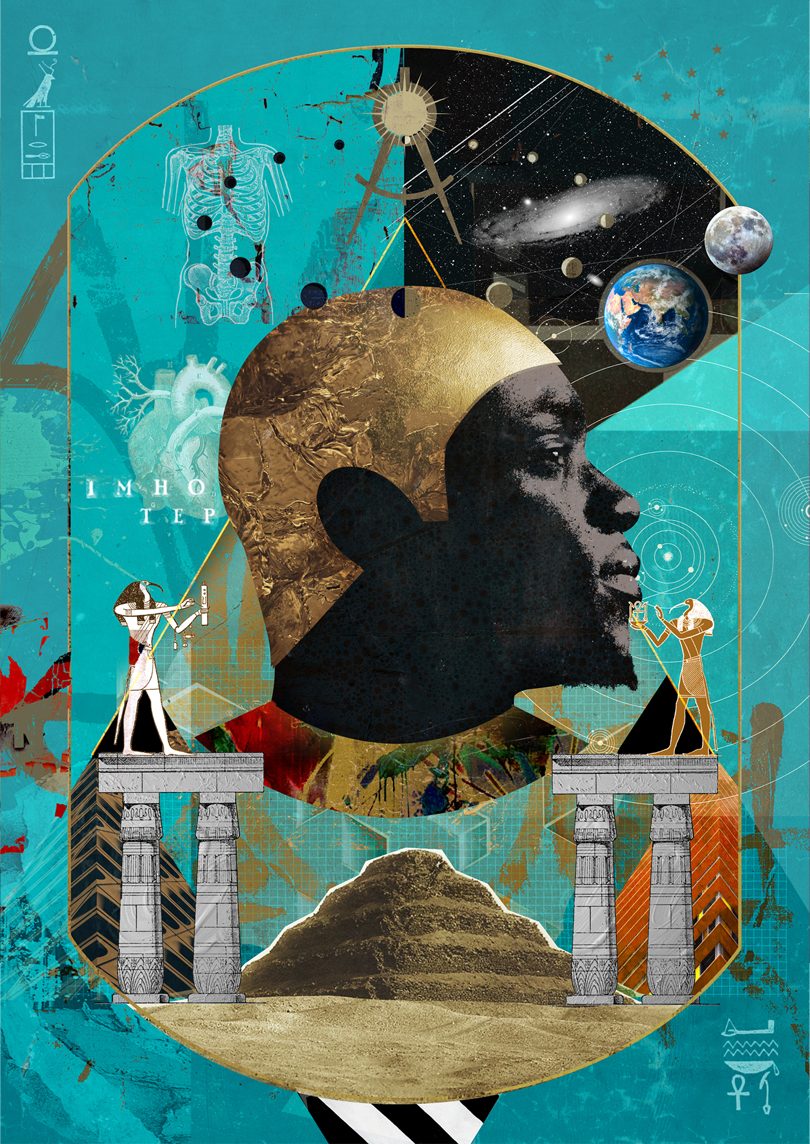
This is a multimedia lesson plan, in which students have a chance to use an artist's interpretation of Imhotep to make some predictions and watch a poetry performance. There is extended reading to learn about the wider context.
Poem
IMHOTEP
5000 years ago a child was born who became a God
But nothing was taught about him in school and I found this odd
His name is Imhotep, and through his life, he achieved many things
That resulted in Imhotep going from a common man to being worshiped by kings
Imhotep was born in Kemet and served under King Djoser as chancellor to the Pharaoh Imhotep had an amazing appetite for knowledge about things people didn’t know
Imhotep was an intellect with vision and amazing wisdom
Which is why Imhotep advised the next 3 kings on the ruling of the kingdom
Imhotep is regarded as the first architect who designed the step pyramid
Which still stands today as a testament to just one of the great things Imhotep did
Imhotep was a great physician who diagnosed and treated over 200 diseases Imhotep performed surgery, dentistry, and extracted medicine from plants and trees
Imhotep was a great scribe who recorded what he thought
And through these actions Imhotep’s knowledge could be taught
Imhotep became a high priest that people went to for enlightenment Which Imhotep gave freely as he believed it was everybody’s entitlement
Imhotep had a full life and lived to a grand old age
But when Imhotep died it wasn’t the end of his chapter more like the turning of a page
100 years after Imhotep’s death he was elevated to the position of a medical demigod 2000 years later Imhotep was elevated again but this time to a God
The Egyptians, Greeks and Romans worshiped Imhotep and what he believed And through this understanding of Imhotep’s work much they too achieved
The early Christians worshiped Imhotep too and viewed him as one with Christ Which goes to show that Imhotep was viewed by many up there with the highest
Imhotep was a man who became a God because of people’s belief in him Which is a remarkable achievement when we look at Imhotep’s beginning
So no matter where your life may start you never know where it will end And that is the message from these words I would like to send
Lawrence Hoo
Download teachers notes